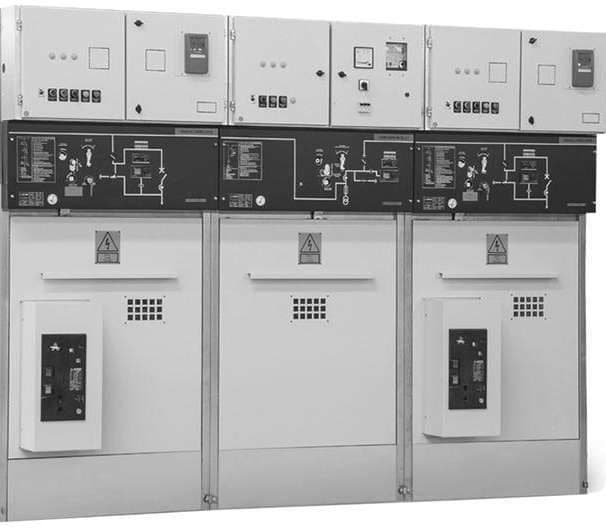
Metal clad switchgear is designed to IEC 62271-200 for use up to 40.5 kV. It is used to distribute electrical energy in demanding applications such as power generation plants, utility substations, cement and petrochemical works, mines, airports, railways and shopping centres, and provides control and protection for transformers, capacitors and motors.
Its principal strengths are service continuity for the network, optimised investment over the life of the installation, the ability to bring the medium voltage installation into a remote monitoring and control system, withstand of 31.5 kA for 3 seconds against high current and short circuit, and withdrawable switching devices that can be exchanged easily between panels. Because other compartments and functional units can remain energised while one accessible compartment is open, personnel protection is maintained at a high level.
The panel consists of five main compartments separated by metal shutters, with moving shutters and insulated bushings at the transitions. Compartment A is the low voltage compartment and contains all secondary circuits for protection, monitoring and communication. Compartment B is the circuit breaker compartment, housing the SF6 or vacuum circuit breaker, vacuum contactor, fused voltage transformer, mechanisms, interlocks and moving shutter. Compartment C is the busbar compartment, holding electrolytic copper conductors selected for the rated current together with insulators and bushings. Compartment D contains the withdrawable fuse and voltage transformer assembly, with safety ensured by mechanical interlocks and the shutter mechanism. Compartment E is the cable compartment and contains the current transformer, voltage transformer, surge arrester, earthing switch, capacitive voltage divider, and cable glands and connection components.
The cable compartment can be equipped with an earthing switch for earthing the cable. The same device can also be used to earth the busbar system and can be mounted directly on the main busbar system in a dedicated compartment. The earthing switch has short circuit making capacity; it is operated manually from the front of the panel and can optionally be motorised. Its position is visible from the front through a mechanically linked indicator.
The panels have been subjected to all tests required by international IEC standards and local standards organisations. They have successfully passed the type tests prescribed by IEC standards at internationally accredited independent laboratories such as KEMA, ICMET and LVT. Applied type tests include short-time and peak withstand current, internal arc, temperature rise, making and breaking capacity of circuit breakers and contactors, mechanical operation of the circuit breaker and earthing switch, dielectric testing and earthing switch making capacity.
Five metal clad panel types are available: incoming/outgoing panel, bus coupler panel, voltage metering panel, bus riser panel with disconnector and bus riser panel.