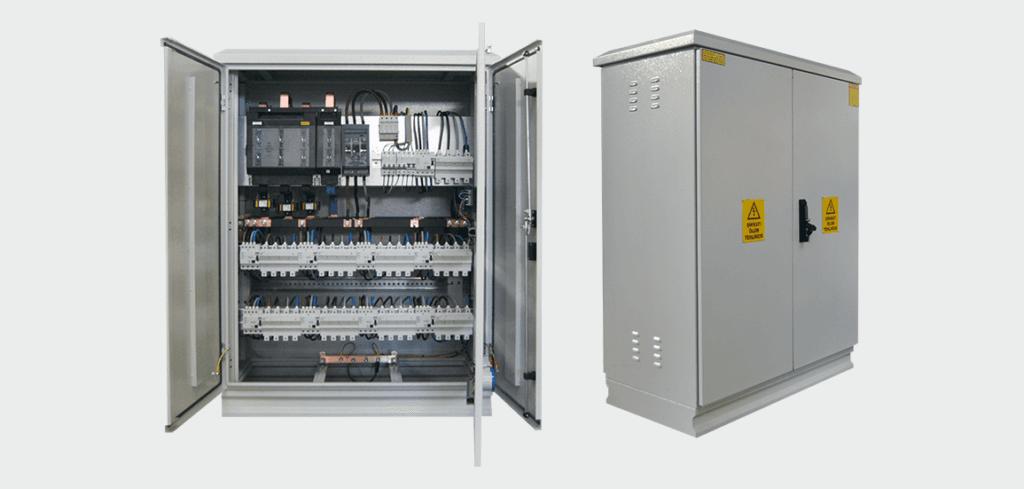
The rectifier groups meet the requirements of the 'Battery Rectifier Group' section of TEDAŞ specification TEDAŞ-MLZ-2018.65.A. Electrical safety and functional type tests have been carried out to IEC/TS EN 60146-1-1, and EMC and EMI type tests to IEC/TS EN 61000-6-2 and 61000-6-4. Operating temperature has been verified by IEC/TS EN 60068-2-1 and 60068-2-2 type tests.
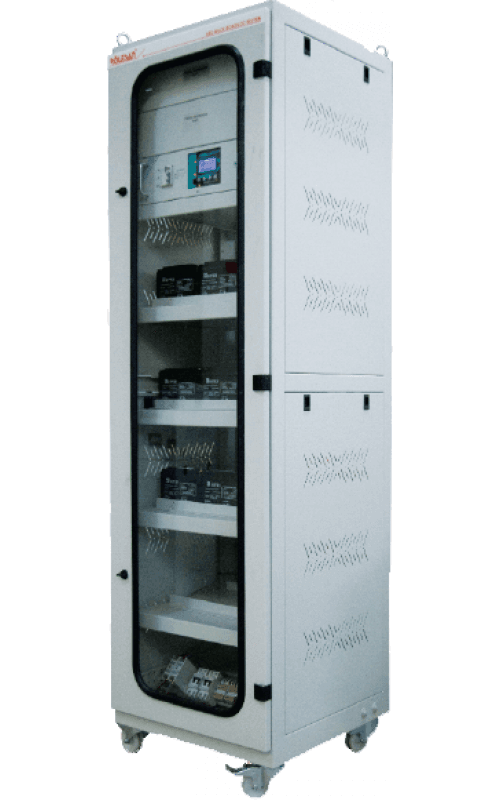
The BAR 24 series battery rectifier group is a DC power supply with an internal battery bank inside its cabinet, available in 7, 12, 18 and 26 Ah capacities. Input is 230 V AC (±20%) at 47.5–52.5 Hz; output is 26.7 Vdc at 2 or 5 A maximum. Dielectric withstand is 2 kVac/50 Hz for one minute, impulse withstand 5 kVpeak, and the operating range −25 to +55 °C.
The RDS Bar 24 V DC group delivers 10 A maximum output with an internal battery capacity of 12–200 Ah. The RDS Bar 110 V DC group provides 121 Vdc output, 10 A maximum and 18 Ah internal battery capacity. Both have IP 22 ingress protection. The thyristor rectifier is safer and longer-lived than FET-based rectifiers. The internal VRLA (AGM) batteries need no maintenance, handle high current demand and have a low discharge rate.
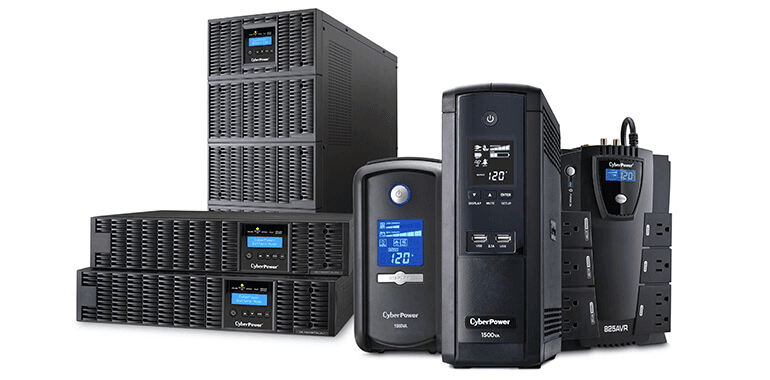
On the single phase UPS side there are 600 VA–2000 VA and 1500 VA line-interactive models, together with 1000/2000/3000 VA true sine wave output models. Common features are microprocessor control, buck and boost automatic voltage regulation (AVR), intelligent battery management with deep discharge protection, short circuit and overload protection, lightning and low voltage protection, cold start, energy saving and a USB communication port. The true sine wave models are also suitable for lift systems.
Three phase models are offered in 60–800 kVA, 10–400 kVA and 10–60 kVA ranges. IGBT rectifier and inverter, DSP-controlled processor, active input power factor correction (PF > 0.99) and active harmonic correction (THDi < 3%) are standard. They operate correctly with generators, and the parallelling capability allows redundancy and capacity expansion — up to six units in parallel on the 60–800 kVA series.
Three phase models also feature intelligent battery charging, temperature-compensated charging, standard backfeed protection, static and manual bypass, a standard output isolation transformer, easy synchronisation with external sources and an ECO energy saving mode. The on-line double conversion series holds output voltage harmonics below 1.5% and supports external battery banks for extended autonomy.